



If you’ve been ignoring your brake fluid — you’re not alone, and you’re not being reckless. Most Canadian drivers focus on oil changes, tires, and brake pads. Brake fluid (also called brake oil) quietly sits in its reservoir doing the most critical job in your car: making sure you actually stop when you press the pedal.
But here’s the part that gets overlooked. Canada’s climate is uniquely brutal on brake fluid. Freeze-thaw cycles, road salt, extreme temperature swings between -30°C winters and +35°C summers — these conditions accelerate moisture contamination in your brake system faster than the manufacturer’s standard global recommendations account for. What’s good enough advice in California isn’t good enough advice in Bolton, Ontario.
This guide covers everything you need to know: how often to change brake oil in Canada, why Canadian driving conditions change the math, what the warning signs look like, and exactly what happens inside your brake lines when you wait too long.
How Does Brake Oil (Brake Fluid) Work?
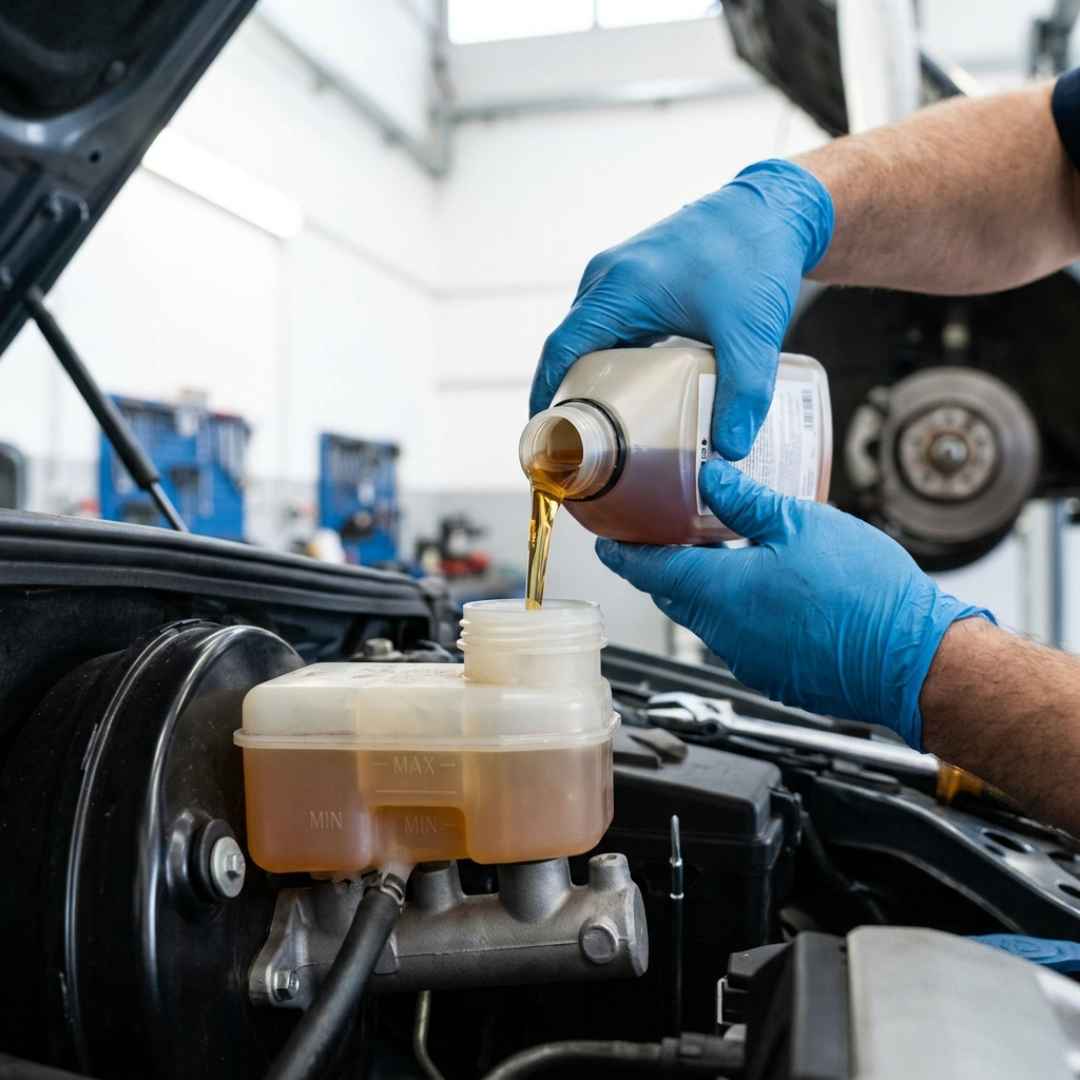
First, let’s clear something up: “brake oil” and “brake fluid” are the same thing. The term “brake oil” is commonly used by drivers, especially in South Asian communities across Canada, but automotive technicians call it brake fluid. Both terms refer to the hydraulic fluid that lives inside your brake lines, master cylinder, and calipers.
When you press your brake pedal, you’re not mechanically clamping anything. You’re applying force to a small piston, which compresses brake fluid through sealed lines. That compressed fluid then pushes the brake caliper pistons outward, clamping the brake pads against the rotor. Without fluid, this chain reaction doesn’t happen. No fluid pressure = no braking.
The three most common types you’ll encounter in Canadian vehicles:
- DOT 3 — The standard for most older domestic vehicles. Glycol-based, absorbs moisture over time.
- DOT 4 — Higher boiling point than DOT 3. Common in newer vehicles, European cars, and performance vehicles. Also glycol-based.
- DOT 5.1 — Higher performance yet, often used in high-demand brake systems. Still glycol-based (not to be confused with DOT 5, which is silicone-based and doesn’t mix with others).
Your owner’s manual specifies which type your vehicle requires. Never mix incompatible types — it can damage seals and cause unpredictable brake behavior.
How Often Should You Change Brake Oil in Canada? (The Real Answer)
Here’s the honest answer, broken down by scenario:
General Canadian Recommendation
Every 2 years or 40,000–60,000 km, whichever comes first.
This is the standard recommendation from major Canadian automotive service providers and aligns with most manufacturer guidelines adjusted for our climate. The global average is often cited as 2–3 years, but Canadian technicians consistently shorten this to 2 years because of how aggressively our environment degrades brake fluid.
If You Drive in Demanding Conditions — Push It to Every 1–2 Years
You should consider annual brake fluid service if you:
- Drive in heavy stop-and-go traffic in areas like the Greater Toronto Area, Highway 400 corridor, or Bolton’s growing commuter routes
- If you’re towing trailers, boats, or heavy loads, your brakes will be significantly heated, and the fluid breakdown will be accelerated
- Drive a performance vehicle or luxury European car — these systems run hotter and are more sensitive to fluid quality
- Live in areas with prolonged harsh winters like Northern Ontario or the Prairies, where freeze-thaw cycles are more extreme
- Drive older vehicles (10+ years) with aging rubber seals that allow faster moisture ingress
Even If It “Looks Fine” — Change It Anyway
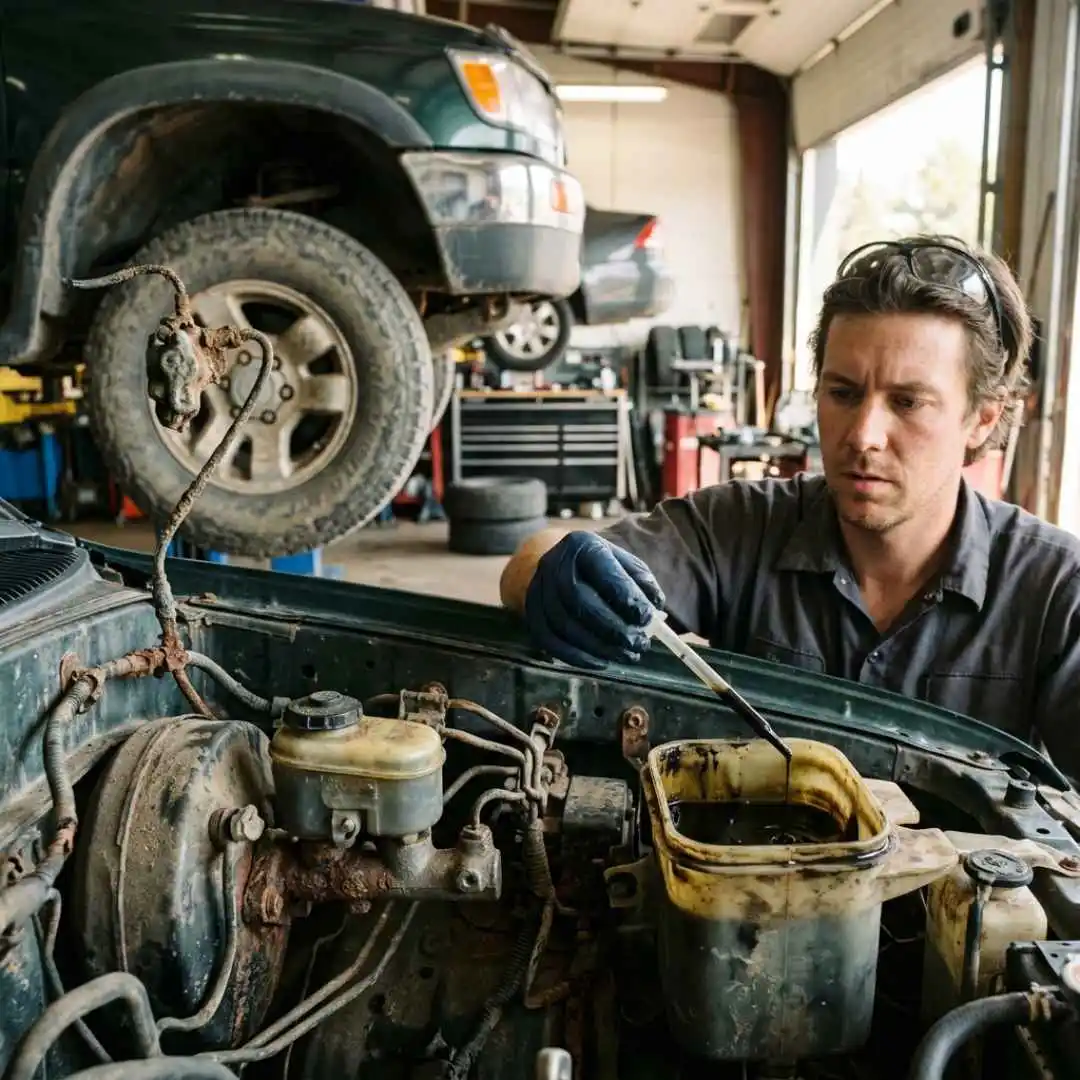
This is the biggest misconception in brake maintenance. Fresh brake fluid is clear or very light amber. Contaminated fluid turns dark brown or even black. But here’s the trap: brake fluid can absorb dangerous levels of moisture while still looking relatively clear.
A brake fluid’s color alone is not a reliable indicator of its health. The only reliable test is a moisture content test, which any qualified shop can perform in minutes using a test strip or electronic tester.
The Canadian Climate Factor: Why Your Brake Fluid Degrades Faster Here
Brake fluid is hygroscopic — meaning it actively absorbs moisture from the surrounding environment. This is actually by design. The fluid absorbs moisture to prevent it from pooling inside brake components and causing localized corrosion. But there’s a limit. Once moisture content exceeds roughly 3–3.5% by volume, the fluid’s boiling point drops significantly, and problems begin.
In a temperate climate, this absorption happens slowly. In Canada, it happens faster because of:
1. Freeze-Thaw Cycling When moisture-laden fluid freezes and thaws repeatedly through a Canadian winter, it puts stress on brake seals and accelerates moisture infiltration. Every thermal cycle is another opportunity for micro-expansion in the rubber hoses that connect your brake components.
2. Road Salt Exposure Ontario and most of Canada use aggressive road salt from October through April. Salt accelerates corrosion on any exposed metal, including brake line fittings and caliper housings. When these components corrode even slightly, their seal integrity degrades — letting in more moisture faster.
3. Extreme Temperature Swings The difference between a Bolton January (-20°C) and a Bolton July (+33°C) is over 50 degrees. This swing causes the fluid and its container components to expand and contract repeatedly, working moisture in through microscopic gaps over time.
4. High Humidity in Southern Ontario The Great Lakes region — which includes Bolton and the rest of the GTA area — experiences significant humidity, particularly in summer. Humidity speeds up moisture absorption in brake fluid through rubber hoses, which are permeable by design.
What Happens When You Don’t Change Brake Fluid Often Enough
This isn’t scare-mongering. The consequences follow a predictable, documented progression.
Stage 1: Lowered Boiling Point
As the moisture content rises, the boiling point of your brake fluid drops. Fresh DOT 4 fluid has a dry boiling point of approximately 230°C. At just 3% moisture contamination, this can fall below 155°C. That sounds like it’s still hot enough — until you’re driving down a long hill with a loaded SUV in Ontario summer heat and you’re repeatedly applying your brakes.
Stage 2: Brake Fade
When contaminated fluid reaches its reduced boiling point under heavy use, it vaporizes. Gas is compressible. Liquid is not. When your brake lines contain vapor bubbles, pressing the pedal compresses gas instead of transmitting pressure. The pedal goes soft or spongy. Braking distance increases. This is called “brake fade,” and it is an emergency.
Stage 3: ABS System Interference
Modern vehicles depend on ABS (Anti-lock Braking System) and electronic stability systems that rely on fluid pressure sensors operating within precise parameters. Contaminated, moisture-laden fluid doesn’t behave consistently. It can cause ABS to activate erratically or fail to activate when needed.
Stage 4: Internal Corrosion
Over months and years, moisture in the brake system causes rust inside the master cylinder, brake lines, and calipers. You won’t see this damage until a component seizes or fails. Replacing a seized caliper in Canada typically costs $300–$600 per corner. Depending on the vehicle, replacing rusted brake lines can cost $500 to $1500. A brake fluid flush costs a fraction of any of those repairs.
Comparison Table: Brake Fluid Change Intervals by Driver Type
| Driver Profile | Recommended Interval | Notes |
|---|---|---|
| Average commuter (city/suburban) | Every 2 years / 40,000 km | Applies to most Bolton-area drivers |
| Heavy city traffic / frequent stops | Every 1–1.5 years | GTA commuter routes, construction zones |
| Towing/hauling (trucks, SUVs) | Every 1–2 years | Trailer brakes stress the system significantly |
| Performance / European vehicle | Every 1–2 years | Higher operating temps demand fresher fluid |
| Older vehicle (10+ years) | Every 1–2 years | Aged seals increase the moisture ingress rate |
| Low-mileage driver (retired, occasional) | Every 2 years, regardless of km | Time matters as much as mileage |
| High-altitude driving (mountain passes) | Every 1–2 years | Extended downhill braking accelerates heat |
Warning Signs Your Brake Oil Needs Changing Now
Don’t wait for your next scheduled service if you notice any of these. Book a brake inspection immediately.
- Spongy or soft brake pedal — The pedal feels less firm than usual, or travels further before resistance kicks in. This is a red flag for moisture or air in the lines.
- Pedal pulsation — The pedal vibrates or pulses under pressure. Can indicate caliper issues worsened by fluid contamination.
- Longer stopping distances — Your vehicle takes noticeably more distance to stop. This is the one you cannot afford to ignore.
- Brake warning light — Modern vehicles increasingly monitor fluid condition. If the light comes on, don’t dismiss it.
- Dark or murky fluid in the reservoir — Lift the hood and look at the brake fluid reservoir. It’s a translucent white plastic container near the firewall. Clear or light amber = okay. Dark brown or black = time to change.
- Burning smell after hard braking — Can indicate overheated, degraded fluid under stress.
- ABS activating in normal conditions — If your ABS kicks in on dry pavement during normal stops, degraded fluid may be affecting sensor readings.
Myth vs. Fact: Brake Fluid Edition
| Myth | Fact |
|---|---|
| “If it looks clear, it’s fine.” | Visual appearance doesn’t reflect moisture content. Fluid can be clear and still contain 3%+ water. Only a test strip or electronic tester confirms the actual condition. |
| “No need to flush, just top it off.” | It is not possible to remove contaminated fluid from lines and calipers by topping them off. Only a complete flush replaces the system’s fluid. |
| “Brake fluid lasts the life of the car.” | No major manufacturer endorses this. All recommend periodic changes. Some vehicles even have dashboard indicators for it. |
| “Flushing brake fluid is unnecessary if brakes feel fine.” | Brake fade typically only occurs under heavy use. Your brakes can feel fine in daily driving while being dangerously compromised in an emergency stop situation. |
| “DOT 3 and DOT 4 are interchangeable.” | They are compatible (DOT 4 can go into a DOT 3 system), but not interchangeable without consequence. Always use the specification in your owner’s manual. |
DOT Fluid Types: A Quick Reference for Canadian Drivers
Understanding what’s in your system helps you ask the right questions at the shop.
DOT 3
- Dry boiling point: ~205°C | Wet boiling point: ~140°C
- Common in: older domestic vehicles, light passenger cars
- Glycol-based. Absorbs moisture. Compatible with DOT 4.
DOT 4
- Dry boiling point: ~230°C | Wet boiling point: ~155°C
- Common in: most modern vehicles, European cars, light trucks
- Higher boiling point makes it better suited to Canadian summer heat cycles. Most widely used in the Bolton and the GTA area vehicles.
DOT 5.1
- Dry boiling point: ~260°C | Wet boiling point: ~180°C
- Common in: performance vehicles, heavy-duty applications
- Glycol-based (compatible with DOT 3/4). Superior performance but typically unnecessary for standard passenger vehicles.
DOT 5
- Dry boiling point: ~260°C | Does NOT absorb moisture
- Silicone-based. Incompatible with DOT 3, 4, and 5.1. Used in specialty vehicles, military equipment, and some classics. Do not confuse with DOT 5.1.
The Real Cost of Brake Fluid Service in Canada (Bolton, Ontario Area)
Brake fluid flushes are one of the most affordable preventive maintenance services available. Here’s a realistic cost breakdown for Canadian drivers:
- Brake fluid itself: $15–$35 per liter (DOT 4 quality). Most vehicles require 0.5–1 liter for a complete flush.
- Labor at a professional shop: $60–$120 typically, depending on vehicle type and local rates.
- Total average cost: $80–$150 for a complete brake fluid flush
Compare this to:
- Seized brake caliper replacement: $300–$600 per corner
- Rusted/damaged brake line repair: $500–$1,500
- ABS module replacement (due to contamination damage): $800–$2,500
- The cost of a collision because your brakes faded on a wet Ontario highway: Incalculable.
Brake fluid service is not where you find savings. It’s where you prevent the expensive repairs — and the dangerous moments.
📍 Ready to get your brake fluid tested or changed? Bolton, Ontario’s trusted auto care team. We test your brake fluid for free and tell you honestly whether it needs changing.
From the Shop Floor: What Our Technicians See Every Day in Bolton
“The single most common thing we see at Shahsspaandtirelube is vehicles that have gone 4, 5, even 6 years without a brake fluid change. The owners always say the same thing: ‘My brakes feel fine.’ And they usually do — in normal driving. But when we test the moisture content, the numbers tell a different story. We’ve pulled vehicles off the lift with fluid readings well above the 3% moisture threshold, where the boiling point has dropped enough that a hard stop on the 427 in summer heat could cause real fade. The freeze-thaw cycle we get in Bolton and across Ontario is genuinely one of the hardest environments for brake fluid in North America. We recommend our customers come in every two years, no matter what — and we do the moisture test at no charge.”
At Shahsspaandtirelube in Bolton, Ontario, we service everything from daily commuter vehicles to commercial trucks, SUVs, and performance cars. We use professional brake flush equipment that performs a complete system exchange — not just a top-up — and we verify fluid condition with a moisture content test before and after service.
Don’t worry, we won’t upsell you. We’ll show you the test result and let the number speak for itself.
How the Brake Fluid Change Process Actually Works
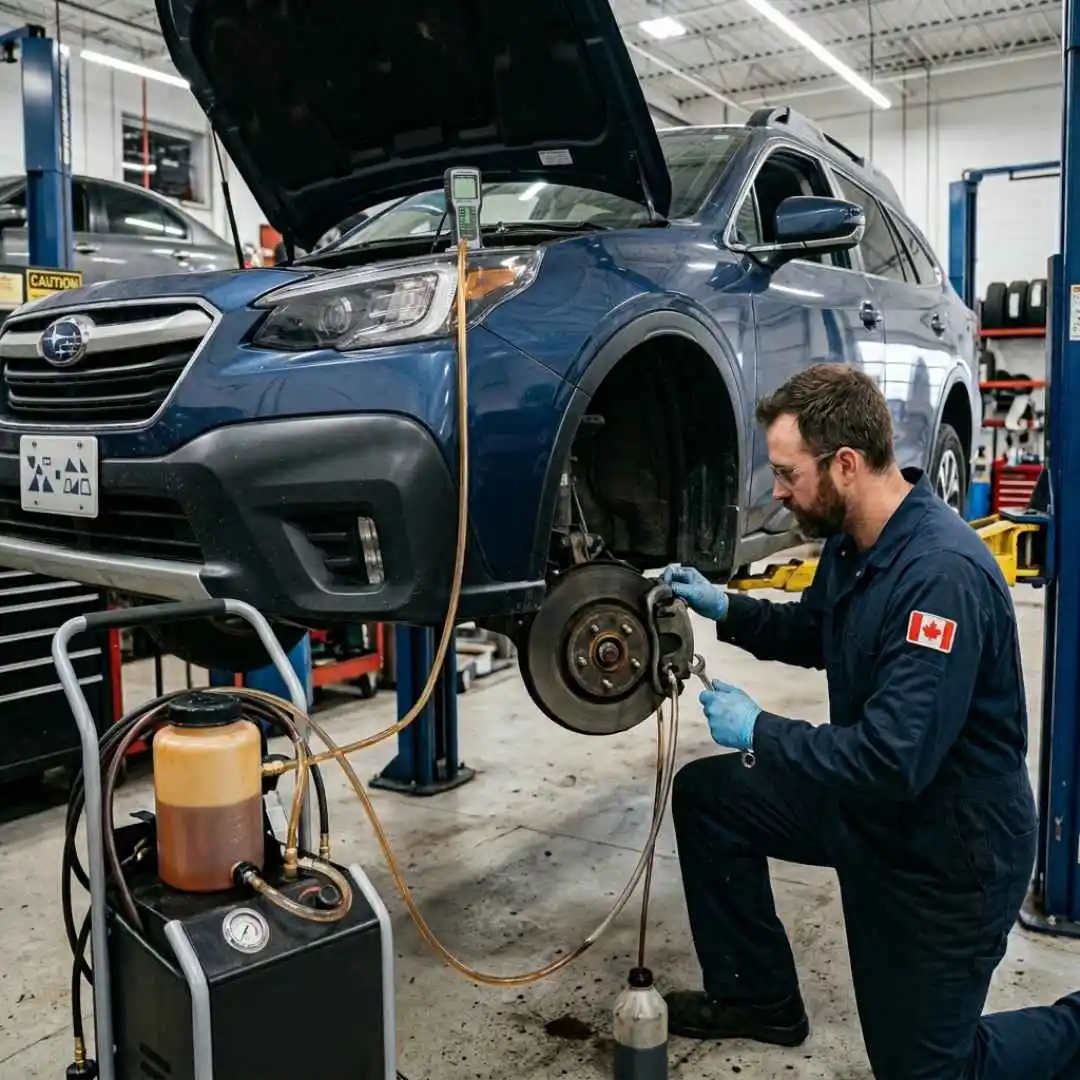
You might wonder what “changing brake fluid” actually involves. Here’s what happens at a professional shop like Shahsspaandtirelube:
- Initial Moisture Test — A test strip or electronic tester is inserted into the brake fluid reservoir. This gives a moisture percentage reading in about 60 seconds. This tells us whether you actually need a flush, not just whether you’re due by calendar.
- Visual Inspection — The technician inspects the reservoir for discoloration, debris, and any signs of contamination or seal degradation.
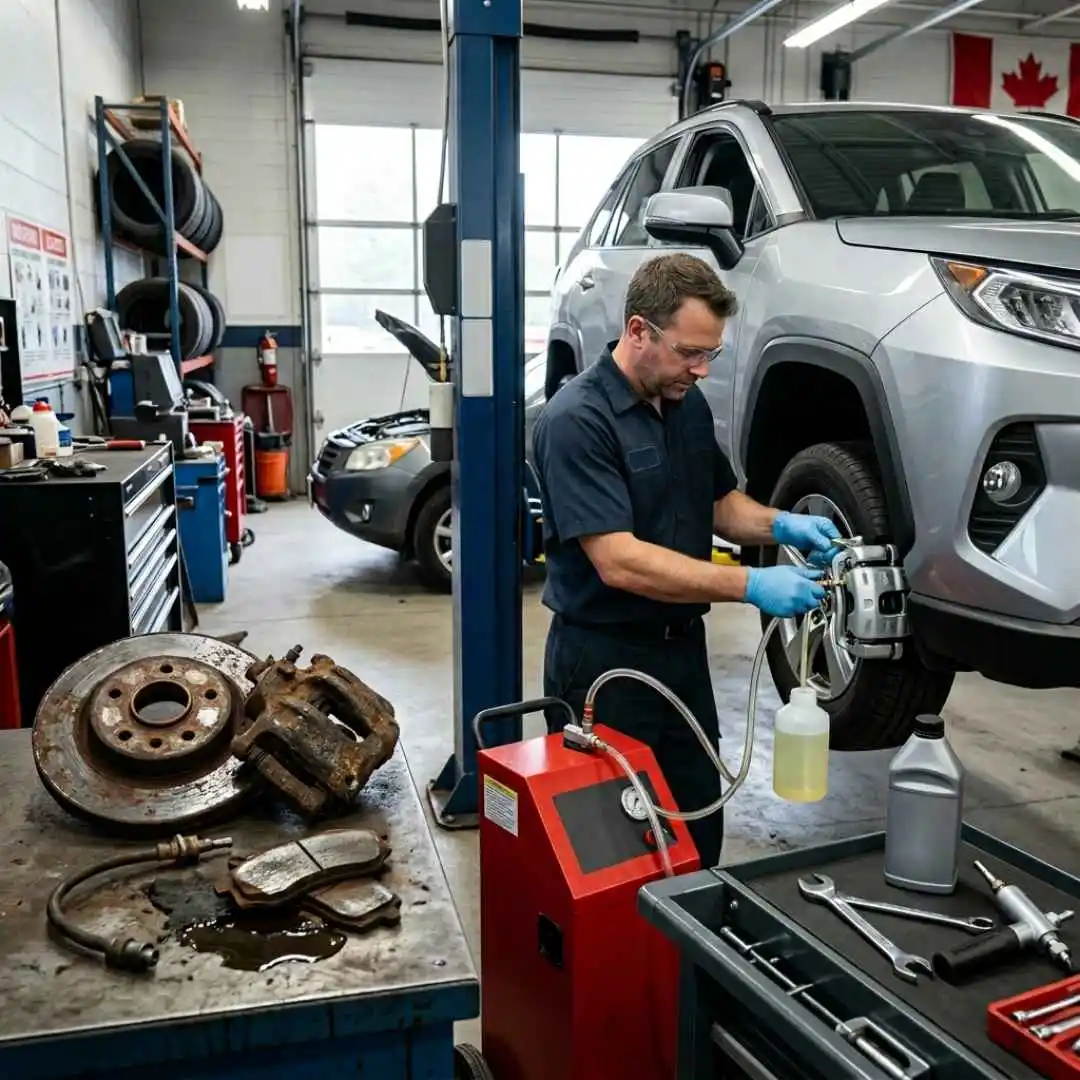
- Pressure Flush — Using a brake flush machine, old fluid is pushed out of the system under pressure while new fluid is simultaneously fed in. This ensures complete replacement of fluid in the lines, calipers, and master cylinder — not just the reservoir. Manual bleeding can leave old fluid trapped in the calipers.
- Brake Bleeding — Each caliper bleed screw is opened in sequence (typically from the furthest wheel from the master cylinder to the closest) to ensure all air is purged from the lines.
- Final Check — Fluid level is confirmed, reservoir is sealed, and a test drive confirms firm, consistent pedal feel.
Total time: approximately 30–60 minutes at a properly equipped shop.
FAQs: Brake Oil Change in Canada — Quick Answers
How often should I change brake oil in Canada?
Every 2 years or 40,000–60,000 km, whichever comes first. Canadian winters, road salt, and humidity accelerate moisture contamination compared to milder climates, so don’t stretch to the 3-year mark that some global manufacturers’ guides suggest.
Is “brake oil” the same as “brake fluid”?
Yes. Brake oil and brake fluid refer to the same hydraulic fluid used in your brake system. DOT 3, DOT 4, and DOT 5.1 are all commonly called brake oil or brake fluid interchangeably.
Can I just top off brake fluid instead of doing a full flush?
Topping off only refills the reservoir. It does not remove contaminated, moisture-laden fluid from your brake lines, calipers, or master cylinder. A full flush is the only way to properly restore brake fluid quality. If the level is low, you should also have the system inspected for leaks.
What are the signs that my brake fluid needs to be changed?
The most accurate way is a moisture content test, which any shop can do in under a minute. Visual cues include dark or murky fluid and a spongy pedal feel, but clear-looking fluid can still be dangerously contaminated. When in doubt, test it — don’t guess.
Does brake fluid type matter in Canadian winters?
Yes. DOT 4 is generally preferred over DOT 3 for Canadian driving because its higher boiling point gives more margin under thermal stress from summer heat and heavy braking. Always follow your manufacturer’s specification — never downgrade from DOT 4 to DOT 3.
What’s the cost of a brake fluid flush in Bolton, Ontario?
Most drivers pay between $80–$150 for a professional brake fluid flush, depending on vehicle type. At Shahsspaandtirelube in Bolton, we offer transparent pricing and a complimentary moisture test. Book Now to get an accurate quote for your vehicle.
Conclusion: How Often to Change Brake Oil
Brake fluid is a two-year job in Canada. Not three years. This does not apply to “whenever the pedal feels off.” This does not apply to “whenever someone else mentions it.” Two years — or 40,000–60,000 km — regardless of what the fluid looks like.
The cost of a brake flush is roughly what you’d spend on a decent dinner out. The cost of a failed caliper, a corroded brake line, or an ABS failure at the wrong moment is exponentially higher — in money, and potentially in consequences that no amount of money fixes.
Canadian roads don’t forgive neglected brake systems. The salt, the cold, the humidity, the freeze-thaw cycles — they’re working on your brake fluid right now, whether you’re thinking about it or not.
If you haven’t had your brake fluid checked in two years or more, treat this article as your reminder.
📍 Visit Shahsspaandtirelube in Bolton, Ontario for a free brake fluid moisture test. We’ll check it, show you the reading, and give you an honest answer. No pressure, no guesswork.
About Shahsspaandtirelube
Shahsspaandtirelube is Bolton, Ontario’s full-service auto maintenance and tire centre, serving drivers across the Bolton, Caledon, and Brampton area. Our services include oil changes, tire installation and rotation, brake system service, fluid flushes, and complete preventive maintenance. We’re committed to transparent service — you’ll always know exactly what we found, what it means, and what it costs before we touch your vehicle.
Leave a Reply